7 Truly Indestructible Dog Toys for Power Chewers
Heavy-duty chew toys for power chewers, judged by material, size and how they fail — with long-standing options compared.
Affiliate Disclosure: FurReviews earns commissions from qualifying purchases. That does not affect what we recommend. Learn more

How we chose
- Material, in three tiers — natural rubber, nylon and dense composites — and how each fails when it does fail.
- Size against the dog's jaw: a toy that fits behind the back teeth is a choking risk, however tough.
- Tooth safety: anything too hard to dent with a thumbnail can fracture teeth, following veterinary dental guidance.
- Whether the maker offers a replacement guarantee, which says more than the word 'indestructible' does.
Not judged: How long a toy survives your dog. Chewing strength varies too much for any lifespan claim to hold.
Researched from labels, specifications and published guidance — we did not test these products. Editorial policy
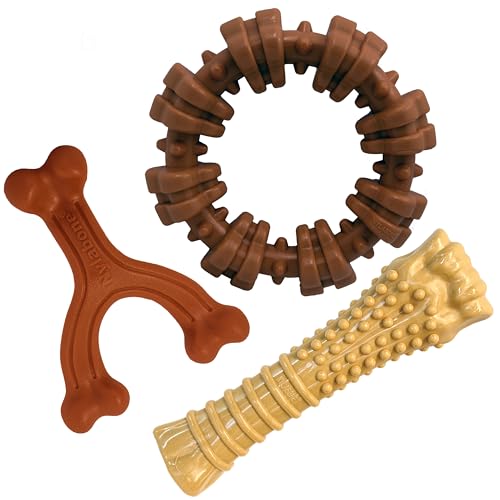
No dog toy is indestructible, whatever the packaging says. What you can judge before buying is the material, the size relative to your dog's jaw, and whether the toy fails safely. This guide explains how to judge those, with long-standing options such as the KONG Classic, Benebone, Nylabone, BarkBox Super Chewer toys, the Chuckit! Ultra Ball and Outward Hound puzzle feeders used as examples.
How this guide was put together: we compared manufacturer specifications, labels, published guidance and reported owner experience. We have not tested these products ourselves, and nothing here is veterinary advice. Durability notes come from materials and reported owner experience, not from a chew test of our own.
"Indestructible" is marketing. Here is what to actually judge.
No dog toy is indestructible, and a manufacturer that says otherwise is telling you something about its marketing rather than its product. What varies is how long a toy survives a particular dog, and what happens when it finally fails.
That second part matters more than the first. A toy that wears down into harmless shavings over months is in a different safety category from one that splits into swallowable chunks. Judge on failure mode, not on claimed toughness.
The three material tiers
Natural rubber is the middle ground and the one most vets are comfortable with. It flexes under the tooth rather than the tooth flexing under it, so it survives serious chewing while being far kinder to teeth. It is the default recommendation for a power chewer.
Hard nylon lasts longest and carries the highest tooth-fracture risk. Veterinary dentists routinely treat slab fractures of the large upper chewing teeth caused by hard chews, antlers and bones, and those usually end in extraction.
Plush and rope are for gentle mouthing. A power chewer destroys both in minutes, and the hazards are the squeaker, the stuffing and — with rope — swallowed strands, which behave as a linear foreign body in the gut and are a surgical emergency.
The two tests worth knowing
Veterinary dentists repeat these because they work:
Good rubber passes both. Nylon, antlers, hooves and real bones fail both.
Size up, always
A toy that fits entirely inside a dog's mouth is a choking hazard regardless of how tough it is. Buy the size band for your dog's weight, and go up if in doubt.
Sizing up is also cheaper in practice — a large dog with an undersized toy destroys it far faster.
Make any toy last longer
Check any peanut butter you stuff with is xylitol-free — xylitol, sometimes labelled birch sugar, is toxic to dogs — and count what goes in as part of the day's food.
When to bin a toy
The moment you see chunks missing, a deep split, a torn opening, exposed stuffing, or a toy worn small enough for the dog to get its whole mouth around.
Swallowed rubber, nylon fragments, stuffing and rope strands can all cause an intestinal obstruction, which is a surgical emergency. Replacing a toy early is cheap by comparison.
Chewing itself is not the problem
Destructive chewing in an adult dog is usually boredom, under-exercise or anxiety rather than a toy failure. A dog getting enough physical exercise, enough nose work and enough mental occupation chews less.
If a dog only destroys things when left alone, and the destruction is focused on doors and windows, that is separation distress rather than chewing, and it needs a behaviour plan rather than a tougher toy.
Products Mentioned in This Article



📋 Affiliate Disclosure: FurReviews is reader-supported. When you buy through links on our site, we may earn an affiliate commission at no extra cost to you. This does not influence what we recommend. We compare specifications, materials and reported owner experience rather than testing products in a lab, and we say so on every page. Read our full disclosure
Frequently Asked Questions
Are any dog toys genuinely indestructible?
No, and a manufacturer claiming otherwise is describing its marketing. What matters more than claimed toughness is the failure mode: a toy that wears down into harmless shavings over months is far safer than one that splits into swallowable chunks.
Is rubber or nylon better for a power chewer?
Rubber for most dogs. It flexes under the tooth rather than the tooth flexing under it, so it is far kinder to teeth while still surviving serious chewing. Hard nylon lasts longer and carries a real tooth-fracture risk — veterinary dentists routinely treat slab fractures caused by hard chews, antlers and bones.
How do I know a chew toy is too hard?
Two tests dentists repeat. If you cannot dent it with your thumbnail, it is hard enough to fracture a tooth. And if you would not want to be struck on the kneecap with it, neither would your dog's teeth. Nylon, antlers, hooves and real bones fail both.
When should I throw a dog toy away?
As soon as you see chunks missing, a deep split, a torn opening, exposed stuffing, or a toy worn small enough for the dog to get its whole mouth around it. Swallowed rubber, nylon, stuffing and rope strands can all cause an obstruction needing surgery.
Why does my dog destroy every toy?
Usually boredom, under-exercise or anxiety rather than a toy problem. Rotate toys so they stay novel, use food-stuffed frozen toys that occupy a dog far longer, and add nose work. If the destruction happens only when alone and targets doors and windows, that is separation distress and needs a behaviour plan.

