
KONG
KONG Classic Dog Toy
A long-established natural rubber chew toy sold in several toughness levels, including one for power chewers. Can be stuffed with food.
View on AmazonLast updated: 2026-04-05
How we researched this: we compared the manufacturer's specifications and label claims, published guidance and reported owner experience. We have not tested this product ourselves, and nothing here is veterinary advice. Editorial policy
Strengths
- Several toughness levels
- Stuff with treats
- Sold through veterinary channels
- Multiple sizes available
Drawbacks
- Can be destroyed by extreme chewers
- Needs to be cleaned regularly
- Plain design
KONG Classic Dog Toy: In-Depth Research
Editorial analysis by the FurReviews team, based on manufacturer specifications, published guidance and reported owner experience. We have not tested this product ourselves.
Why this toy outlasted every trend
The KONG Classic is a hollow, bouncing rubber cone with an opening at each end. It has barely changed in decades because the design solves three separate problems at once: it survives chewing, it dispenses food slowly, and it bounces unpredictably.
The food-dispensing part is what makes it more than a toy. A dog working at a stuffed KONG is doing sustained, calm, problem-solving work — which is the kind of mental tiredness that settles a dog, as opposed to the physical tiredness of a ball chase that often winds them up further.
Sizing, and why the shelf label is not enough
KONG sizes by weight band, and the bands overlap across a wide range. Two rules beat the label:
The colour code is the firmness grade, and it matters as much as the size:
| Colour | Grade | Suits |
|---|---|---|
| Blue / pink | Puppy | Soft rubber for developing teeth, puppies only |
| Red | Classic | The default adult dog |
| Black | Extreme | Power chewers who destroy the red one |
| Purple | Senior | Softer, for older mouths and worn teeth |
A puppy KONG given to an adult power chewer will be destroyed, and that is a failure of grade choice rather than of the product.
Stuffing it, from easy to genuinely difficult
Start easy or the dog gives up. Build difficulty as the dog gets good at it.
Two safety notes. Check that any peanut butter you use is xylitol-free — xylitol, sometimes labelled birch sugar, is toxic to dogs and appears in some sugar-free spreads. And count what goes in the KONG as part of the day's food, or you will be adding a meal a day without noticing.
Cleaning, which is not optional
Food residue inside a rubber toy goes rancid and grows bacteria. The Classic is dishwasher safe on the top rack, which is the easiest route. A bottle brush reaches the inside if you wash by hand.
A KONG that smells sour has been left too long, and dogs will still eat from it.
Separation, crate training and the actual use case
The strongest practical use of a KONG is not play. It is changing how a dog feels about a moment it dislikes.
Give a frozen, well-stuffed KONG at the moment you leave the house, or at the moment the crate door closes, and you pair the thing the dog dislikes with the best fifteen minutes of its day. Done consistently, this is one of the most effective low-effort tools in home dog training.
It is not a treatment for genuine separation anxiety, which is a distressing condition needing a structured behaviour plan and often veterinary support. If your dog panics, destroys doors, or injures itself when alone, a stuffed toy is not the answer and a behaviourist is.
When to throw one away
Rubber degrades. Inspect it regularly and bin it when you see chunks missing, deep splits, or a torn opening. Swallowed rubber fragments can cause an intestinal blockage, which is a surgical emergency.
No toy is indestructible, and the Extreme grade is a very tough toy rather than a permanent one.
Who should look elsewhere
If your dog is a shredder that ingests what it destroys, supervise every session regardless of grade. If you want a slow feeder for a full meal, a puzzle bowl holds more. And if the goal is a dog that is physically tired, a KONG is the wrong tool — it tires the brain, not the legs, and most dogs need both.
KONG Classic Dog Toy: Common Questions
What size and colour KONG do I need?
Size by the dog's weight band and go up if in doubt — too small is a choking risk. Colour is firmness: blue or pink for puppies only, red for the average adult, black for power chewers, purple for seniors with worn teeth. An adult chewer given a puppy KONG will destroy it.
What can I stuff a KONG with?
Start with loose kibble so it falls out easily, then pack kibble with a sticky binder like plain yoghurt, wet food or plain unsweetened pumpkin. Freezing it makes it last far longer. Check any peanut butter is xylitol-free — xylitol, sometimes labelled birch sugar, is toxic to dogs.
How do I clean it?
Top rack of the dishwasher, or by hand with a bottle brush. Do not leave stuffed food inside between sessions — residue in rubber goes rancid and grows bacteria, and dogs will happily eat from a sour toy.
Will a KONG help with separation anxiety?
A frozen stuffed KONG given at the moment you leave is excellent for building a positive association with departures, and it is one of the best low-effort training tools there is. It is not a treatment for true separation anxiety — a dog that panics, destroys doors or injures itself alone needs a behaviour plan and often veterinary support.
When should I replace it?
When you can see chunks missing, deep splits, or a torn opening. Swallowed rubber can cause an intestinal blockage that needs surgery. Even the Extreme grade is a very tough toy rather than an indestructible one.
Where to Buy
As an Amazon Associate, FurReviews earns from qualifying purchases at no extra cost to you.
Similar Products You Might Like

Chuckit!
Chuckit! Ultra Ball Dog Toy
High-bounce, ultra-durable rubber ball designed for the game of fetch. Compatible with Chuckit! launchers.
+ Extremely bouncy
+ Floats in water
- Not for aggressive chewers
- Gets dirty easily
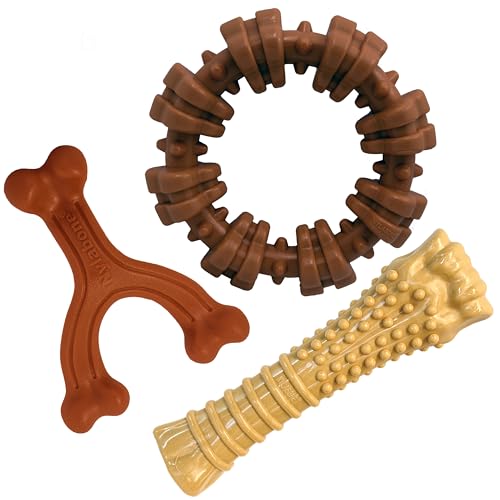
Nylabone
Nylabone Power Chew Durable Dog Toy
Tough nylon chew toy with textured surface for powerful chewers up to 50 lbs. Bacon flavored.
+ Hard nylon
+ Textured surface
- Not edible
- Can splinter over time

BarkBox
BarkBox Super Chewer Rubber Bone
Heavy-duty rubber chew toy designed for aggressive chewers. Peanut butter scented with treat-dispensing holes.
+ Built for power chewers
+ Treat dispensing
- Strong smell fades
- Can stain carpet
