
Benebone
Benebone Wishbone Durable Dog Chew Toy
Wishbone-shaped nylon chew infused with real bacon flavor throughout. Ergonomic design for easy gripping.
View on AmazonLast updated: 2026-03-30
How we researched this: we compared the manufacturer's specifications and label claims, published guidance and reported owner experience. We have not tested this product ourselves, and nothing here is veterinary advice. Editorial policy
Strengths
- Real flavor throughout
- Ergonomic shape
- USA made
- Long lasting
Drawbacks
- Not edible
- Hard on teeth
- Replace when worn
Benebone Wishbone Durable Dog Chew Toy: In-Depth Research
Editorial analysis by the FurReviews team, based on manufacturer specifications, published guidance and reported owner experience. We have not tested this product ourselves.
The hardness question, which decides everything
Nylon chews like this one are hard. That is the point — it is why they last months rather than an afternoon — and it is also the single thing to weigh before buying one.
Veterinary dentists warn about hard chew objects fracturing teeth, particularly the large upper carnassial teeth that dogs use for serious chewing. Slab fractures from hard chews, antlers, bones and hooves are a routine finding in veterinary dentistry, and they often need extraction.
The commonly repeated home tests are the thumbnail test — if you cannot make a mark in it with your thumbnail, it is hard enough to break a tooth — and the kneecap test, which is whether you would be happy being hit on the kneecap with it. Nylon chews generally fail both.
That does not make them unusable. It means using them with awareness:
Softer alternatives exist — rubber chews flex and are far kinder to teeth — and a dog with a history of dental problems should be on those instead.
What the wishbone shape actually buys
The Y shape is the design's real idea and it works. Two arms let the dog pin the chew against the floor with its paws while working the third arm with the back teeth, where dogs actually want to chew.
A straight bone rolls away, so the dog spends its time chasing it. This one stays put. That difference is why the shape has been copied widely.
"Flavour throughout" versus a coating
The flavour is mixed into the nylon rather than sprayed on the surface. That matters: a coated chew loses its appeal within a session or two, and then sits ignored under the sofa. A chew flavoured all the way through stays interesting as it wears down.
The flavour is not food. The chew is not digestible, and the dog gets nothing nutritionally from it.
Wear, shavings and when to bin it
A dog chewing nylon produces small shavings. Tiny quantities passing through are generally expected with this class of product, but that is different from swallowing a chunk.
Replace it when:
A chew that has become small enough to swallow is a choking and obstruction hazard, and obstruction is a surgical emergency. Sizing up and replacing early are both cheap compared with that.
Sizing
Buy for the dog's size and go up if in doubt. A chew that fits fully inside a dog's mouth is the dangerous size. It is also worth knowing that a big dog with a small chew will destroy it far faster, so sizing up saves money as well.
What this is not
It is not a dental product. Chewing gives some mechanical abrasion, but it does not replace tooth brushing, and the products with actual evidence behind them are on the Veterinary Oral Health Council's accepted list. If dental health is the goal, brushing daily beats every chew on the shelf.
It is also not a toy to leave with a dog that suffers when alone. A chew given at departure helps build a positive association, but genuine separation anxiety needs a behaviour plan, not an object.
Who should look elsewhere
If your dog has a history of fractured teeth or dental disease, choose a flexible rubber chew instead. If your dog swallows what it destroys rather than gnawing, no hard chew is safe unsupervised. And if the goal is dental health rather than occupation, brushing plus a chew from the Veterinary Oral Health Council's accepted list is the evidence-based route.
Benebone Wishbone Durable Dog Chew Toy: Common Questions
Are nylon chews safe for dogs' teeth?
They carry a real risk. Veterinary dentists routinely treat slab fractures of the large upper chewing teeth caused by hard chews, antlers and bones. Two common home tests: if you cannot dent it with a thumbnail, or would not want to be hit on the kneecap with it, it is hard enough to break a tooth. Supervise, limit sessions, and choose flexible rubber for a dog with dental history.
When should I replace it?
When any arm is worn to a nub the dog could get its whole mouth around, when you see cracks or a sharp edge, when pieces flake off rather than shaving, or when the end nubs are gone. A chew small enough to swallow is a choking and obstruction risk, and obstruction is surgery.
Is my dog supposed to eat the shavings?
Small shavings passing through are generally expected with nylon chews. Swallowing a chunk is different and is a veterinary problem. If your dog breaks pieces off rather than gnawing shavings, this is the wrong type of chew for that dog.
Why the wishbone shape?
Two arms let the dog pin the chew against the floor with its paws while working the third arm with the back teeth, where dogs prefer to chew. A straight bone rolls away and the dog spends its time chasing it rather than chewing.
Does chewing clean my dog's teeth?
Only partly. Chewing gives some mechanical abrasion but does not replace brushing. If dental health is the goal, daily brushing beats every chew, and the products with real evidence behind them are on the Veterinary Oral Health Council's accepted list.
Where to Buy
As an Amazon Associate, FurReviews earns from qualifying purchases at no extra cost to you.
Similar Products You Might Like

KONG
KONG Classic Dog Toy
A long-established natural rubber chew toy sold in several toughness levels, including one for power chewers. Can be stuffed with food.
+ Several toughness levels
+ Stuff with treats
- Can be destroyed by extreme chewers
- Needs to be cleaned regularly

Chuckit!
Chuckit! Ultra Ball Dog Toy
High-bounce, ultra-durable rubber ball designed for the game of fetch. Compatible with Chuckit! launchers.
+ Extremely bouncy
+ Floats in water
- Not for aggressive chewers
- Gets dirty easily
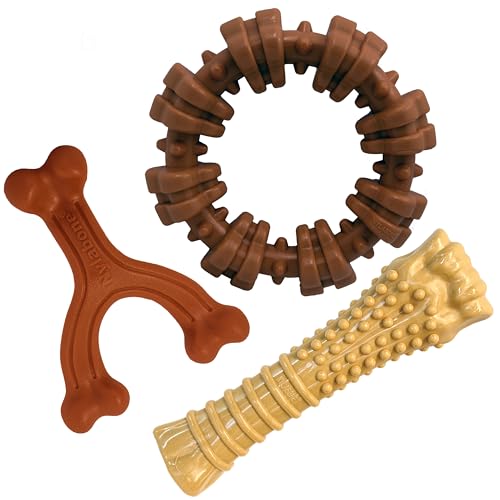
Nylabone
Nylabone Power Chew Durable Dog Toy
Tough nylon chew toy with textured surface for powerful chewers up to 50 lbs. Bacon flavored.
+ Hard nylon
+ Textured surface
- Not edible
- Can splinter over time
