Wellness
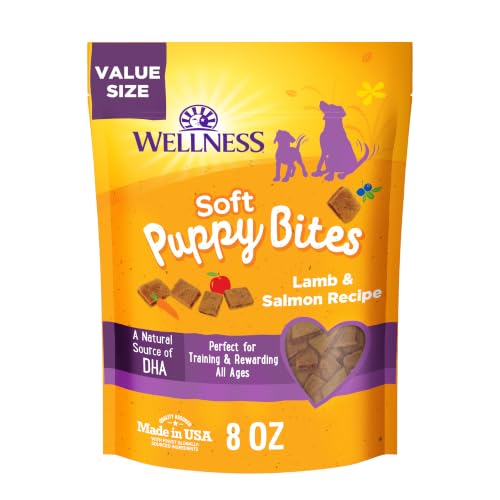
Wellness Soft Puppy Bites Grain-Free Treats
Grain-free soft treats specifically formulated for puppies. Made with lamb and salmon, with added DHA.
View on AmazonLast updated: 2026-04-10
How we researched this: we compared the manufacturer's specifications and label claims, published guidance and reported owner experience. We have not tested this product ourselves, and nothing here is veterinary advice. Editorial policy
Strengths
- Puppy-specific formula
- Added DHA
- Grain-free
- Soft texture for puppy teeth
Drawbacks
- Small bag size
- Premium price
- Only one flavor
Wellness Soft Puppy Bites Grain-Free Treats: In-Depth Research
Editorial analysis by the FurReviews team, based on manufacturer specifications, published guidance and reported owner experience. We have not tested this product ourselves.
Why puppy treats are a different product
Three things separate a good puppy treat from an adult one, and only one of them is nutrition.
Size. A puppy's mouth is small and a training session needs many repetitions. Treats need to be pea-sized or smaller, and breakable smaller still.
Texture. Soft treats are swallowed in a second, which keeps a training session flowing. A puppy that has to stop and crunch loses the thread, and hard treats are also uncomfortable for a puppy that is teething.
Calorie density. Puppies are small and treats add up fast. Keep treats under about ten per cent of daily calories and subtract them from meals rather than adding them on top — overfeeding a growing puppy matters more than overfeeding an adult.
The thing that matters most in a puppy's first months
It is not the treat. It is the socialisation window, and it closes.
The period up to roughly sixteen weeks is when a puppy forms its lasting view of what is normal and safe. Positive, controlled exposure during it — to other dogs, to people of different appearances, to traffic, to floor surfaces, to handling, to vet-style examination, to being alone — does more for a dog's lifetime welfare than anything else you will do.
The window does not reopen. A dog that met almost nothing before sixteen weeks is far more likely to be fearful as an adult, and fearfulness is the root of most serious behaviour problems.
Treats are the tool for that work: something genuinely good happening at the same moment as a new thing. That is what a bag of soft puppy treats is actually for.
Ask your vet about safe socialisation before a puppy is fully vaccinated. Carrying a puppy out to watch the world, and meeting known healthy vaccinated dogs, is usually possible and is worth doing.
DHA, honestly
DHA is an omega-3 fatty acid with a genuine role in neural and retinal development, and there is reasonable evidence for it in puppy nutrition. Complete puppy foods are formulated with it for that reason.
In a treat, the amount is small. Treat it as a sensible inclusion rather than a reason to buy — the puppy's actual food is where DHA intake comes from.
Large-breed puppies need particular care
This is the one nutritional point that genuinely matters and it is easy to miss.
Overfeeding a large or giant breed puppy, and getting the calcium balance wrong, is associated with developmental orthopaedic disease. Growth that is too fast is a risk factor.
Treats count toward daily intake in that calculation.
Grain-free in a puppy treat
The FDA's diet-associated DCM investigation concerned complete diets rather than treats, and the amounts involved in occasional treats are small. Still, if you have chosen grain-inclusive food because of that open question, it is reasonable to apply the same logic to a daily treat.
Grain allergy in dogs is also uncommon — the most frequently reported food allergens are animal proteins — so grain-free is not, in itself, a reason to buy.
Training technique matters more than the treat
Foods to avoid
Who should look elsewhere
If you are training intensively, budget for volume and use measured kibble for easy repetitions. If your puppy is a large or giant breed, watch total intake carefully, treats included. And if your puppy is fearful of something, work with a qualified trainer during the socialisation window rather than hoping it grows out of it.
Sources for health information
- AAFCO — pet food labels and nutrient profiles
- WSAVA Global Nutrition Committee — selecting a pet food
- U.S. FDA Center for Veterinary Medicine — animal food, drugs and safety alerts
- ASPCA Animal Poison Control Center — toxic foods, plants and products
- American Veterinary Medical Association — pet owner resources
Wellness Soft Puppy Bites Grain-Free Treats: Common Questions
How many treats can a puppy have?
Keep treats under about ten per cent of daily calories and subtract them from meals rather than adding them on top. Overfeeding a growing puppy matters more than overfeeding an adult, and it matters most in large and giant breeds, where fast growth is associated with developmental joint problems.
What makes a good puppy training treat?
Small enough to be swallowed instantly — pea-sized or smaller — soft, because a teething puppy should not have to crunch and a crunch breaks the flow of a session, and aromatic enough to be worth working for. Non-crumbly matters too, or the puppy hoovers the floor instead of watching you.
What is the socialisation window?
Roughly the period up to sixteen weeks, when a puppy forms its lasting view of what is normal and safe. Positive controlled exposure during it does more for a dog's lifetime welfare than anything else you will do, and the window does not reopen. Ask your vet about safe socialisation before full vaccination — carrying a puppy out to watch the world usually is possible.
Does DHA in treats help brain development?
DHA has a genuine role in neural and retinal development and complete puppy foods are formulated with it for that reason. The amount in a treat is small, so treat it as a sensible inclusion rather than a reason to buy — the puppy's actual food is where DHA intake comes from.
Should I give my large-breed puppy calcium supplements?
Not unless a vet tells you to. Getting the calcium balance wrong in a large or giant breed puppy is associated with developmental orthopaedic disease. Use a food whose AAFCO statement covers growth of large-size dogs, keep the puppy lean, and follow your vet's guidance on growth rate.
Where to Buy
As an Amazon Associate, FurReviews earns from qualifying purchases at no extra cost to you.
Similar Products You Might Like

Zuke's
Zuke's Mini Naturals Training Treats
Soft, moist training treats made with real chicken. Under 3 calories per treat, perfect for training sessions.
+ Under 3 calories each
+ Real chicken first ingredient
- Small size
- Can crumble in pocket

Blue Buffalo
Blue Buffalo Dental Bones
Dental chew bones marketed to clean teeth and freshen breath. Made with wholesome ingredients and added vitamins.
+ Marketed for dental care
+ No artificial flavors
- Messy to eat
- Calories add up

Blue Buffalo
Bits Soft Dog Treats for Training
Blue Buffalo dog treats listed for comparison. We have not yet researched this product in depth — check the full specifications on the retailer's page.
