
Sleepypod
Sleepypod Clickit Sport Dog Car Harness
A crash-tested car harness. The maker states it is tested to a child-restraint standard; three attachment points spread crash forces across the chest.
View on AmazonLast updated: 2026-04-10
How we researched this: we compared the manufacturer's specifications and label claims, published guidance and reported owner experience. We have not tested this product ourselves, and nothing here is veterinary advice. Editorial policy
Strengths
- Maker cites a child-restraint crash standard
- Three-point design
- Vest-style comfort
- Doubles as a walking harness
Drawbacks
- Expensive
- Difficult sizing
- Bulky
Sleepypod Clickit Sport Dog Car Harness: In-Depth Research
Editorial analysis by the FurReviews team, based on manufacturer specifications, published guidance and reported owner experience. We have not tested this product ourselves.
Why an ordinary harness is not a car restraint
A walking harness is built to withstand a dog pulling. A crash applies forces on a completely different order.
In a collision, an unrestrained dog becomes a projectile. That is a danger to the dog, and a serious danger to the people in the car. It is also why a walking harness clipped to a seatbelt is a poor idea: the hardware and the stitching are not designed for crash loads, the force concentrates on a narrow strap, and a harness that fails at the wrong moment leaves a loose dog in a crashed vehicle.
Car restraint is a separate product category from walking equipment, and they are not interchangeable.
Crash testing is not a regulated label
This is the thing to understand before comparing products.
There is no mandatory government crash-test standard for pet restraints in most jurisdictions. Any manufacturer can print "crash tested" on a package without saying what test, at what speed, with what dummy weight, or whether it passed.
What distinguishes a serious product is the specifics: which standard was used, at what test speed, with what weight of test dog, and whether results are published. Independent testing by a third party is stronger than in-house testing.
Testing to a child-restraint standard is the strongest claim available in this category, because those standards are demanding and well defined. Where a manufacturer states that, it is worth reading exactly what they tested and how.
We have not conducted or verified crash testing ourselves, and we will not repeat a marketing claim as if we had.
How a car harness should be built
Look for these, whatever the brand:
Fitting it correctly
A correctly built restraint fitted loosely is not a restraint.
Alternatives, and how they compare
The legal position
In some jurisdictions, an unrestrained animal in a vehicle can contribute to a driving offence, and insurers have declined claims where an unrestrained animal was a factor. Check your local rules.
Beyond the law: a loose dog is a distraction, and a dog in a footwell or on a lap is a hazard before any collision happens.
Practical travel notes
Who should look elsewhere
For a large dog, a secured crash-tested crate is often the better system. If you need a walking harness, buy one — a car restraint is not designed for daily walks and a walking harness is not designed for a crash. And if you are comparing crash-test claims, read what was actually tested rather than the phrase on the front of the box.
Sleepypod Clickit Sport Dog Car Harness: Common Questions
Can I use my dog's walking harness in the car?
No. Walking harnesses are built to withstand pulling, not crash forces, and the hardware and stitching are not rated for them. In a collision an unrestrained or inadequately restrained dog becomes a projectile — a danger to itself and to the people in the car.
What does 'crash tested' actually mean?
Less than it sounds, because there is no mandatory government standard for pet restraints in most jurisdictions. Any manufacturer can print it without saying what test, at what speed, with what dummy weight, or whether it passed. Look for the specifics, and for independent third-party testing rather than in-house.
How should a car harness fit?
Measure girth around the deepest part of the chest and follow the sizing chart rather than guessing. Two fingers under any strap, no more. The padded chest plate should sit over the breastbone, not on the throat or across the front of the shoulders, and the tether should be short enough that the dog cannot leave the seat.
Where should my dog travel in the car?
The rear seat, never a front seat with an active airbag — airbags are dangerous to dogs as they are to children. For a large dog, a crash-tested crate secured in the load space is often the better system; an unsecured crate is itself a projectile.
Do I need to replace a harness after a crash?
Yes, even if it looks undamaged. Webbing and stitching are load-bearing and a single impact compromises them — the same rule applies to child car seats for the same reason.
Where to Buy
As an Amazon Associate, FurReviews earns from qualifying purchases at no extra cost to you.
Similar Products You Might Like
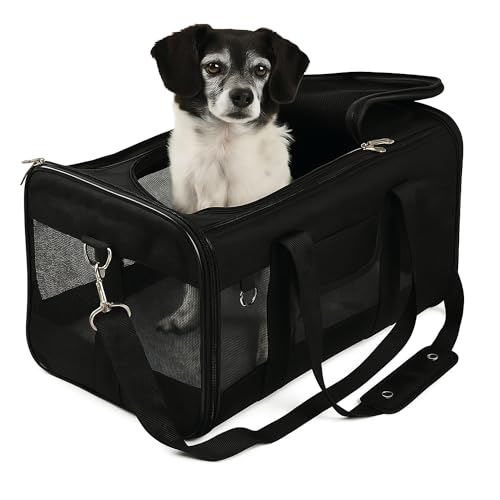
Sherpa
Sherpa Original Deluxe Airline Approved Pet Carrier
Airline approved soft-sided pet carrier with mesh panels and spring wire frame that allows bag to conform to under-seat space.
+ Airline approved
+ Spring wire frame
- Only for small pets
- Zippers can stick

Dog Stroller
Pet Stroller for Small Dogs and Cats
Dog Stroller dog carriers listed for comparison. We have not yet researched this product in depth — check the full specifications on the retailer's page.

K9 Sport
Urban 3 - Medium, Concrete - Ideal for Dogs with 17-19” Back Length…
K9 Sport dog carriers listed for comparison. We have not yet researched this product in depth — check the full specifications on the retailer's page.
