Sherpa
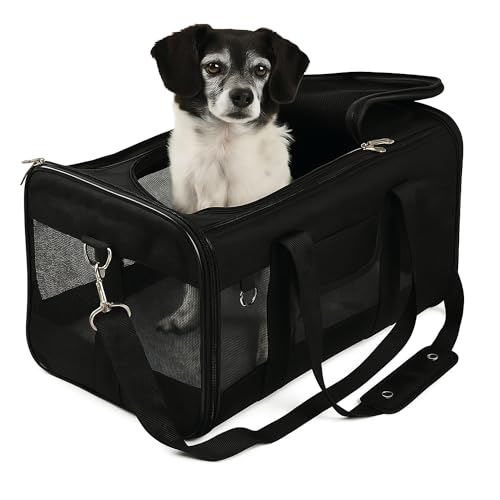
Sherpa Original Deluxe Airline Approved Pet Carrier
Airline approved soft-sided pet carrier with mesh panels and spring wire frame that allows bag to conform to under-seat space.
View on AmazonLast updated: 2026-03-25
How we researched this: we compared the manufacturer's specifications and label claims, published guidance and reported owner experience. We have not tested this product ourselves, and nothing here is veterinary advice. Editorial policy
Strengths
- Airline approved
- Spring wire frame
- Multiple mesh windows
- Machine washable liner
Drawbacks
- Only for small pets
- Zippers can stick
- Shoulder strap uncomfortable
Sherpa Original Deluxe Airline Approved Pet Carrier: In-Depth Research
Editorial analysis by the FurReviews team, based on manufacturer specifications, published guidance and reported owner experience. We have not tested this product ourselves.
"Airline approved" means less than it sounds
This is the single most important thing on this page: no carrier is approved by all airlines, and no manufacturer can guarantee acceptance.
Every airline publishes its own maximum under-seat dimensions, and they differ — sometimes by a few centimetres, which is exactly enough to matter. Aircraft type within the same airline differs too, and the seat you are allocated changes the space available.
So the process is always the same:
A soft-sided carrier with a flexible frame has a genuine advantage here — it can compress somewhat to fit under a seat where a rigid box cannot. That flexibility is the main reason soft carriers dominate in-cabin travel.
In-cabin versus cargo is a different product entirely
In-cabin means the animal travels at your feet in a soft carrier. Cargo means a rigid, bolted, IATA-compliant plastic kennel in the hold.
A soft carrier is never acceptable for cargo travel. If your animal is too large for in-cabin, you need a hard kennel that meets the airline's and IATA's requirements, and that is a substantially different purchase and a substantially different journey.
Also worth knowing: many airlines restrict or refuse brachycephalic breeds — flat-faced dogs and cats such as pugs, bulldogs, Persians — particularly in cargo, because of the genuine respiratory risk. Check before booking anything.
Sizing, which decides comfort and acceptance
The standard requirement is that the animal can stand up, turn around and lie down naturally in the carrier.
Measure the animal:
Then compare against the carrier's internal dimensions, and against the airline's maximum external dimensions. Those two constraints pull in opposite directions, which is why sizing is fiddly, and why some animals genuinely do not have an in-cabin option.
Do not buy a carrier that is comfortably larger than the animal in the hope it is nicer. Airline limits are external, and an animal in a too-large carrier slides around.
Acclimatisation is the part that decides how the journey goes
A carrier introduced on the day of travel is a box the animal is trapped in. A carrier the animal already likes is a den.
Start weeks ahead:
For cats especially this is transformative, and it is the difference between a stressful flight and a quiet one.
Practicalities on the day
Beyond flying
Soft carriers are also the best format for vet visits with cats — a carrier with a top opening lets a vet lift a cat out without dragging it through an end door, which makes appointments far calmer.
Leave the carrier out at home permanently rather than producing it only for vet trips. A carrier that only ever appears before something unpleasant becomes something the cat hides from.
Who should look elsewhere
If your animal must travel in cargo, you need a rigid IATA-compliant kennel, not this. If your animal is over the in-cabin weight or size limit, no soft carrier solves that. And if you are flying a flat-faced breed, check the airline's restrictions before you buy anything at all.
Sherpa Original Deluxe Airline Approved Pet Carrier: Common Questions
Is an 'airline approved' carrier accepted by every airline?
No, and no manufacturer can promise that. Every airline publishes its own maximum under-seat dimensions and they differ, sometimes by a few centimetres. Check your specific airline's current policy on their own site, check the aircraft type, and book the in-cabin pet slot explicitly — they are limited per flight.
What size carrier do I need?
One where the animal can stand up, turn around and lie down naturally. Measure nose to tail base for length and floor to the top of the head or ear tips for height, then check against the carrier's internal dimensions and the airline's maximum external ones. Those two constraints pull opposite ways.
Can I use a soft carrier for cargo travel?
No. Cargo requires a rigid, bolted, IATA-compliant plastic kennel. A soft carrier is for in-cabin travel only. Many airlines also restrict or refuse flat-faced breeds, particularly in cargo, because of the respiratory risk — check before booking anything.
Should I sedate my pet for a flight?
Not without veterinary advice. Sedation can affect breathing and temperature regulation at altitude and many vets advise against it for air travel. If your animal genuinely cannot cope, discuss it with your vet well in advance rather than improvising on the day.
How do I get my cat used to a carrier?
Start weeks ahead and never on the day. Leave it open at home with a familiar blanket, feed meals in it, close the door for seconds then minutes, carry it around, then take short car journeys ending somewhere good. Leaving it out permanently stops it being the thing that only appears before something unpleasant.
Where to Buy
As an Amazon Associate, FurReviews earns from qualifying purchases at no extra cost to you.
Similar Products You Might Like

Sleepypod
Sleepypod Clickit Sport Dog Car Harness
A crash-tested car harness. The maker states it is tested to a child-restraint standard; three attachment points spread crash forces across the chest.
+ Maker cites a child-restraint crash standard
+ Three-point design
- Expensive
- Difficult sizing

Dog Stroller
Pet Stroller for Small Dogs and Cats
Dog Stroller dog carriers listed for comparison. We have not yet researched this product in depth — check the full specifications on the retailer's page.

K9 Sport
Urban 3 - Medium, Concrete - Ideal for Dogs with 17-19” Back Length…
K9 Sport dog carriers listed for comparison. We have not yet researched this product in depth — check the full specifications on the retailer's page.
