
Hill's
Hill's Science Diet Adult Chicken Recipe
Chicken is the first ingredient. The manufacturer states the antioxidant blend has been clinically tested; we have not verified that ourselves.
View on AmazonLast updated: 2026-03-10
How we researched this: we compared the manufacturer's specifications and label claims, published guidance and reported owner experience. We have not tested this product ourselves, and nothing here is veterinary advice. Editorial policy
Strengths
- Widely stocked by vets and pet shops
- Manufacturer cites clinical testing
- No artificial colors/flavors
- Made in the USA
Drawbacks
- Contains grain fillers
- Premium pricing
- Some dogs don't like taste
Hill's Science Diet Adult Chicken Recipe: In-Depth Research
Editorial analysis by the FurReviews team, based on manufacturer specifications, published guidance and reported owner experience. We have not tested this product ourselves.
Why vets recommend this brand more than the boutique ones
This is worth explaining plainly, because it is usually framed as a conspiracy and it is not.
Veterinary nutrition bodies — and the World Small Animal Veterinary Association's diet-selection guidelines in particular — point owners at a set of questions about manufacturers rather than at ingredient lists. The questions are:
Large established manufacturers answer those affirmatively far more often than small boutique brands with better ingredient marketing. That, rather than any inducement, is why the recommendation pattern looks the way it does.
You can apply those questions yourself, to this brand and to whatever you are comparing it against.
Feeding trials versus formulation
This is the most useful label detail nobody reads.
The AAFCO nutritional adequacy statement on a bag tells you two things: which life stage the food is complete and balanced for, and how that was established. Either the food was formulated to meet a nutrient profile on paper, or it was fed to actual dogs in a controlled trial and they stayed healthy.
Feeding trials are the stronger evidence, because a food can meet every number on paper and still be poorly digestible or unpalatable. Relatively few manufacturers run them.
Find that sentence on any bag you are considering. It tells you more than the front of the pack.
Ingredient lists are a weaker signal than people think
Two facts that change how you read a label:
Order is by weight before cooking. Fresh chicken is roughly three-quarters water, most of which is driven off during extrusion, so "chicken" first contributes far less to the finished kibble than its position implies. That is how the labelling rule works everywhere. It is not deception, and it is why ingredient order is a poor comparison tool.
By-products are not automatically bad. In regulatory terms, poultry by-product meal is clean rendered parts — organs like liver, spleen and kidney — which are nutrient-dense and are exactly what a wild canid eats first from a carcass. The word sounds unappetising to humans and means something specific in the rules. Named by-product meal from a manufacturer with real quality control is a perfectly reasonable protein source.
What the clinical-testing claim does and does not mean
The manufacturer states that its antioxidant blend has been clinically tested. We have not verified that ourselves, and we say so rather than repeating it as fact.
The reasonable way to read any such claim: it means the company has run or funded research, which is more than most brands do. It does not mean the effect is large, or that a dog on a different good food is missing something.
Grain-inclusive, which is a feature
This is a grain-inclusive recipe, and after 2018 that matters to many owners.
The FDA opened an investigation that year into reports of dilated cardiomyopathy in dogs eating diets high in peas, lentils, other legume seeds or potatoes — grain-free diets prominently among them — including in breeds without a genetic predisposition. The FDA has since published updates, has not established a causal link, and has said it has not found a definitive relationship. Research continues with mixed findings.
Grain allergy in dogs is also uncommon; the most frequently reported food allergens are animal proteins. So a grain-inclusive food from a manufacturer that runs feeding trials is a straightforwardly defensible choice, and it sidesteps an open question.
Portioning, which matters more than brand
Feed to body condition rather than to the bag. Bag guidelines are population averages across a weight band and tend to be generous.
You should feel the ribs easily with flat hands and light pressure, see a waist behind the ribcage from above, and see the belly tuck up from the side. Adjust the portion monthly to hold that.
Weigh the food rather than scooping it. Kibble density varies by more than a third between foods, so the same cup holds different calories after a food switch — which is how dogs gain weight on an unchanged routine.
Treats, chews and training rewards should stay under about ten per cent of daily calories and come out of the day's total.
Who should look elsewhere
If your dog has a diagnosed condition, a therapeutic diet from your vet is a different product and no over-the-counter food substitutes. If you are investigating a suspected food allergy, a single-protein or hydrolysed diet chosen with your vet is what you need. And if your dog is simply overweight, portion control on the current food usually does more than a new bag.
Sources for health information
- AAFCO — pet food labels and nutrient profiles
- WSAVA Global Nutrition Committee — selecting a pet food
- U.S. FDA Center for Veterinary Medicine — animal food, drugs and safety alerts
- ASPCA Animal Poison Control Center — toxic foods, plants and products
- American Veterinary Medical Association — pet owner resources
Hill's Science Diet Adult Chicken Recipe: Common Questions
Why do vets recommend this brand so often?
Because veterinary nutrition guidelines point owners at manufacturer questions rather than ingredient lists: does the company employ a qualified nutritionist, own its plants, run feeding trials, and control quality on incoming ingredients. Large established manufacturers answer yes to those far more often than boutique brands with better ingredient marketing.
Are by-products bad in dog food?
Not in regulatory terms. Poultry by-product meal is clean rendered parts — organs like liver, spleen and kidney — which are nutrient-dense and exactly what a wild canid eats first from a carcass. The word sounds unappetising to humans and means something specific in the rules.
What is the most useful thing to read on a dog food bag?
The AAFCO nutritional adequacy statement. It tells you which life stage the food is complete for and whether that was established by formulation on paper or by feeding trials on actual dogs. Feeding trials are the stronger evidence, and relatively few manufacturers run them.
Does 'chicken is the first ingredient' mean it's mostly chicken?
Less than it sounds. Ingredient lists are ordered by weight before cooking and fresh chicken is roughly three-quarters water, most of which is driven off during extrusion. That is how the labelling rule works for every brand, which is why ingredient order is a poor comparison tool.
Is grain-inclusive food better than grain-free?
It sidesteps an unresolved question. The FDA opened an investigation in 2018 into DCM reports in dogs eating diets high in legumes and potatoes and has since said it has not established a causal link, with research ongoing. Grain allergy in dogs is also uncommon — the most reported allergens are animal proteins.
Where to Buy
As an Amazon Associate, FurReviews earns from qualifying purchases at no extra cost to you.
Similar Products You Might Like
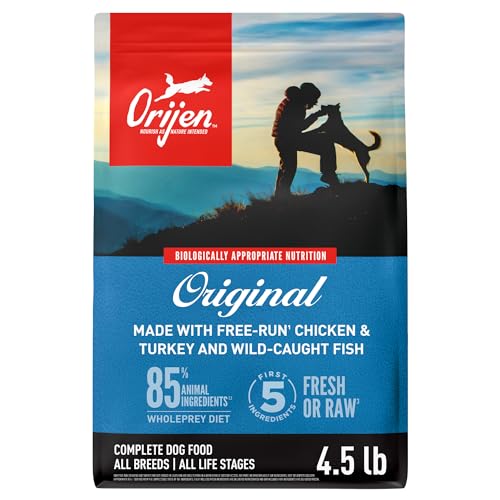
Orijen
Orijen Original Grain-Free Dry Dog Food
Biologically appropriate dog food made with free-run chicken and turkey, wild-caught fish, and cage-free eggs. 85% quality animal ingredients.
+ 85% animal ingredients
+ Grain-free recipe
- Premium price point
- May be too rich for sensitive stomachs

Blue Buffalo
Blue Buffalo Wilderness High Protein Dry Dog Food
High-protein, grain-free recipe inspired by the diet of wolves. Made with real deboned chicken and LifeSource Bits.
+ High protein content
+ LifeSource Bits antioxidants
- Some dogs may have allergies
- Price increased recently

Royal Canin
Royal Canin Size Health Nutrition Medium Adult
Precisely formulated nutrition for medium dogs 23-55 lbs. Marketed for digestive health and stool quality.
+ Size-specific nutrition
+ Sold through veterinary channels
- Contains grains
- Higher price per pound
