Living World
Living World Deluxe Habitat, XL
Extra-large habitat for rabbits and guinea pigs with hybrid upper wire frame and plastic bottom base. Top opening.
View on AmazonLast updated: 2026-03-28
How we researched this: we compared the manufacturer's specifications and label claims, published guidance and reported owner experience. We have not tested this product ourselves, and nothing here is veterinary advice. Editorial policy
Strengths
- Spacious XL size
- Top and front access
- Balcony with ramp
- Hay guard
Drawbacks
- Assembly required
- Water bottle leaks
- Base can crack
Living World Deluxe Habitat, XL: In-Depth Research
Editorial analysis by the FurReviews team, based on manufacturer specifications, published guidance and reported owner experience. We have not tested this product ourselves.
Read the size before anything else
This is the extra-large version of the Living World Deluxe habitat. Cage sizing is where small-pet welfare is won or lost, so start there rather than with features.
The honest position on each species:
If the cage you can afford is smaller than the animal needs, the answer is fewer animals or a connected run, not a smaller animal.
The hybrid design, and what it gets right
Deep plastic base, wire upper frame. That combination is the right one for small mammals and it is the reason this style sells:
Top and front access, and why it matters
Top-opening alone is a problem for prey animals: a hand coming down from above reads as a predator. Front access lets you approach at the animal's level, which makes a nervous guinea pig or rabbit far easier to handle and to health-check.
Top access is genuinely better for cleaning and for lifting things in and out. Having both is the right design.
The known weak points
The listed drawbacks are real and worth planning around.
The water bottle. Included bottles in cage kits are commonly the first thing to fail, and a leaking bottle soaks bedding, which then grows mould and chills the animal. Check it daily for the first week. If it drips, replace it — a leaking bottle is a welfare problem, not an inconvenience. Many guinea pig keepers use a heavy ceramic bowl instead, which is easier to check and easier to clean, though it does get bedding kicked into it.
The base cracking. Thin moulded plastic bases crack at stress points, particularly if the cage is lifted by the wire top with the base loaded. Always lift from underneath the base, and never move the cage while it is full.
Assembly. Clip-together frames loosen. Check the clips every time you deep-clean, especially if the cage lives somewhere it gets knocked.
The balcony and ramp
Platforms add usable area and enrichment. Two cautions worth knowing:
Vertical space is genuinely useful for rats and less so for guinea pigs, which are ground animals. Floor area beats levels for a guinea pig every time.
Bedding, hay and the hay guard
The hay guard is a useful feature because it keeps hay off the floor and reduces waste.
More important: for rabbits and guinea pigs, unlimited grass hay is the bulk of the diet, not bedding. Hay should always be available, in quantity, and it is the single most important thing you feed. Pellets are a supplement to it, not the main event. Guinea pigs additionally need a daily source of vitamin C, which they cannot make themselves.
Spot-clean the wet corner daily and do a full change weekly. That does more for odour than any product.
Who should look elsewhere
If you keep rabbits, plan a pen or free-roam space and treat any cage as a base, not a home. If you keep hamsters, buy something that can hold deep bedding instead. And if you keep guinea pigs, measure the internal floor against the welfare minimum for the number of pigs you have before ordering — guinea pigs must be kept in company, so you are always sizing for two or more.
Living World Deluxe Habitat, XL: Common Questions
Is this cage big enough for a rabbit?
Not as a rabbit's whole living space. Welfare guidance describes enclosures measured in square metres, with room for three consecutive hops and to stand fully upright without the ears touching. A cage this size works as a base within a pen or a free-roam setup, not as the entire home.
How much space do guinea pigs need?
Rescue and welfare guidance commonly puts the minimum at around 7.5 square feet of floor for a pair, and more is better. Guinea pigs are social and should never be kept alone, so always size for at least two. Check the cage's internal floor dimensions against that before buying.
Why does the water bottle leak?
Included bottles in cage kits are a common weak point. A dripping bottle soaks bedding, which grows mould and chills the animal, so treat it as a welfare problem rather than a nuisance. Check it daily for the first week and replace it if it drips; many guinea pig keepers use a heavy ceramic bowl instead.
Can I keep a hamster in this cage?
It is the wrong shape. Hamsters need deep bedding to burrow — 15 to 25 cm for a Syrian — and a wire-topped cage with a shallow base cannot hold that. A large bin cage or a tank suits hamsters far better.
Is the balcony safe?
A low platform with a gently sloped, grippy ramp is fine. Guinea pigs in particular have poor spatial judgement and fragile spines and can injure themselves falling from height, so avoid tall open platforms. Cover slippery plastic ramps with fleece or a fixed towel.
Where to Buy
As an Amazon Associate, FurReviews earns from qualifying purchases at no extra cost to you.
Similar Products You Might Like

Kaytee
Kaytee CritterTrail Two-Level Habitat
Two-level habitat with exercise wheel, water bottle, and food dish. Fun tubes for exploration and enrichment.
+ Fun tube system
+ Multiple levels
- Too small for adult hamsters
- Tubes hard to clean
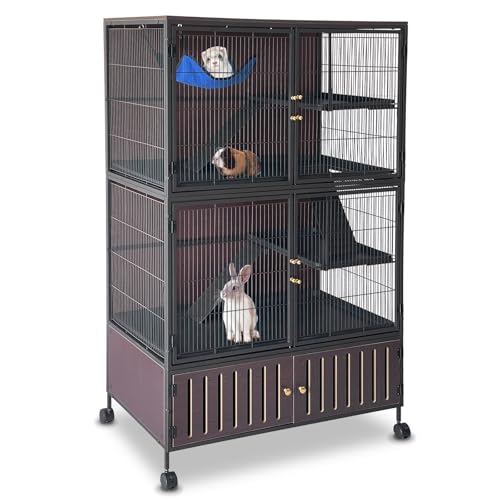
Chinchilla Cage
GarveeHome Large Ferret Cage with Locker
Chinchilla Cage small pet cages listed for comparison. We have not yet researched this product in depth — check the full specifications on the retailer's page.

Hamster Cage
5s Assembly Hamster Cage
Hamster Cage small pet cages listed for comparison. We have not yet researched this product in depth — check the full specifications on the retailer's page.