Kaytee
Kaytee CritterTrail Two-Level Habitat
Two-level habitat with exercise wheel, water bottle, and food dish. Fun tubes for exploration and enrichment.
View on AmazonLast updated: 2026-03-20
How we researched this: we compared the manufacturer's specifications and label claims, published guidance and reported owner experience. We have not tested this product ourselves, and nothing here is veterinary advice. Editorial policy
Strengths
- Fun tube system
- Multiple levels
- Accessories included
- Expandable
Drawbacks
- Too small for adult hamsters
- Tubes hard to clean
- Wheel is noisy
Kaytee CritterTrail Two-Level Habitat: In-Depth Research
Editorial analysis by the FurReviews team, based on manufacturer specifications, published guidance and reported owner experience. We have not tested this product ourselves.
Be honest about who this suits
Tube-and-module habitats are appealing to look at and they have a real sizing problem, so this section comes first.
Syrian hamsters. Current small-animal welfare guidance describes much larger continuous floor areas than a compact modular habitat provides, and Syrians need 15 to 25 cm of bedding depth to burrow. A shallow-based modular cage cannot hold that. For a Syrian, a large bin cage or a big tank is a far better home.
Dwarf hamsters and mice. The floor area is still small by current guidance, though less dramatically so. Deep bedding remains a problem in any shallow base.
Gerbils. Gerbils tunnel constantly and need deep substrate. A modular cage with a shallow base is the wrong shape entirely, and gerbils chew plastic tubes readily.
Where it genuinely works: as an add-on play area or an extension connected to a larger primary enclosure, and as a short-term or travel setup. Tube systems are enrichment. As an entire home for an adult hamster, floor area is the limiting factor and it is limited.
If the cage you can afford is smaller than the animal needs, the answer is a bin cage — a large storage tub with a ventilated lid is inexpensive, enormous by comparison, and holds deep bedding.
The tube problem, in detail
Tubes are the selling point and the chief complaint, for three concrete reasons.
Cleaning. They are long, narrow, curved and difficult to dry. A tube that is damp inside grows mould, and mould in a small enclosure is a respiratory problem. A bottle brush on a flexible handle is essential, and full drying before reassembly is not optional.
Ventilation. Enclosed plastic tubes trap ammonia from urine, and ammonia is a respiratory irritant. Animals that choose to sleep in a tube rather than the nest area are sleeping in the least ventilated part of the habitat.
Size. A Syrian hamster that has grown, or any hamster that has put on weight, can genuinely get stuck in a narrow tube. This is a known risk with narrow-bore tube systems and is a reason many keepers block tubes off for larger animals.
Chewing is the fourth issue: gerbils and some hamsters chew plastic, and a chewed tube has sharp edges.
The included wheel is usually the first thing to replace
Wheels supplied with habitat kits are typically small — often around 12 to 16 cm — and that is too small for a Syrian, which needs about 28 cm or more.
A hamster running with an upward-arched back is on a wheel that is too small, and a chronically arched spine is a welfare problem rather than a preference. Check the diameter against the animal rather than trusting that a wheel supplied with a hamster cage fits a hamster.
Any wheel should also have a continuous solid running surface. Wire rungs catch feet and tails and are associated with bumblefoot.
Water bottles and the daily check
Included bottles are a common weak point across every cage brand. Check it actually delivers water every single day by touching the ball bearing — a bottle that has airlocked or blocked looks completely normal from outside.
A leaking bottle soaks bedding, which grows mould and chills the animal. That is a welfare problem, not an inconvenience.
Making the most of one you already own
Who should look elsewhere
For a Syrian hamster, buy a large bin cage or a tank that can hold deep bedding. For gerbils, the same, because they tunnel and chew plastic. If you already own this, connect it to something bigger and use it as a play area rather than a home.
Kaytee CritterTrail Two-Level Habitat: Common Questions
Is a CritterTrail big enough for a Syrian hamster?
Not as a whole home. Current welfare guidance describes much larger continuous floor areas, and a Syrian needs 15 to 25 cm of bedding depth to burrow, which a shallow-based modular cage cannot hold. It works well as a connected play area or extension to a larger enclosure.
Why are the tubes a problem?
They are hard to clean and dry, and damp tubes grow mould. Enclosed plastic also traps ammonia from urine, which irritates small-animal airways. And a grown or overweight hamster can genuinely get stuck in a narrow-bore tube, which is why many keepers block them off for larger animals.
Is the included wheel big enough?
Usually not for a Syrian. Kit wheels are often around 12 to 16 cm and a Syrian needs about 28 cm or more. A hamster running with an upward-arched back is on a wheel that is too small, and that is a spine problem rather than a preference.
What should I use instead for a hamster?
A large bin cage — a big storage tub with a ventilated lid — is inexpensive, has far more continuous floor area, and holds the deep bedding a burrowing animal needs. A large glass tank with a mesh lid works too.
How do I clean the tubes properly?
A bottle brush on a flexible handle, then dry them completely before reassembling. A tube that goes back damp grows mould, and mould in a small enclosure is a respiratory problem for the animal.
Where to Buy
As an Amazon Associate, FurReviews earns from qualifying purchases at no extra cost to you.
Similar Products You Might Like

Living World
Living World Deluxe Habitat, XL
Extra-large habitat for rabbits and guinea pigs with hybrid upper wire frame and plastic bottom base. Top opening.
+ Spacious XL size
+ Top and front access
- Assembly required
- Water bottle leaks
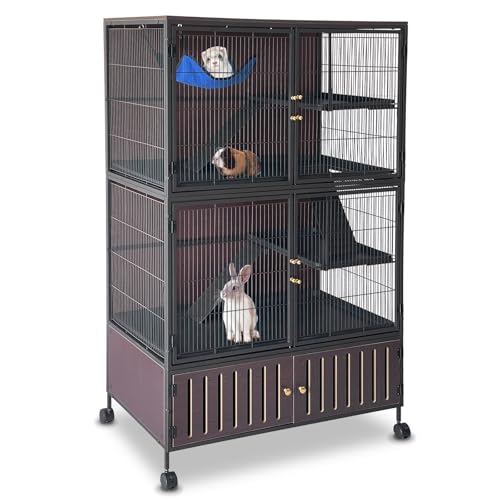
Chinchilla Cage
GarveeHome Large Ferret Cage with Locker
Chinchilla Cage small pet cages listed for comparison. We have not yet researched this product in depth — check the full specifications on the retailer's page.

Hamster Cage
5s Assembly Hamster Cage
Hamster Cage small pet cages listed for comparison. We have not yet researched this product in depth — check the full specifications on the retailer's page.