
Fluker's
Fluker's Heat Mat for Reptiles
Self-adhesive under-tank heater for reptile terrariums. Provides a warm surface for reptiles that need belly heat; always use it with a thermostat.
View on AmazonLast updated: 2026-04-10
How we researched this: we compared the manufacturer's specifications and label claims, published guidance and reported owner experience. We have not tested this product ourselves, and nothing here is veterinary advice. Editorial policy
Strengths
- Self-adhesive
- Even heat distribution
- Multiple sizes
- Affordable
Drawbacks
- No thermostat included
- Can overheat
- Adhesive hard to remove
Fluker's Heat Mat for Reptiles: In-Depth Research
Editorial analysis by the FurReviews team, based on manufacturer specifications, published guidance and reported owner experience. We have not tested this product ourselves.
The single most important thing on this page
Never run a heat mat without a thermostat. Not for a day, not "just to test it".
Under-tank heaters have no internal temperature control. Plugged straight into the wall they run at full output indefinitely, and the surface above them can reach temperatures that cause serious burns. Reptiles do not reliably move away from a surface that is too hot — many species have poor thermal receptors on the belly, which is exactly where this heat is applied — so an animal can sit on a burning surface and stay there.
Thermostat-related burns are one of the most common preventable injuries in home reptile keeping. A thermostat costs a fraction of the vet bill, and far less than the animal.
Use an on/off or pulse-proportional thermostat with the probe secured directly on the surface the animal lies on, inside the enclosure, not taped to the outside of the glass.
What belly heat is for
Many reptiles digest using heat absorbed through the belly from warm ground, not from air temperature. A snake that cannot reach the right belly temperature can fail to digest a meal, which leads to regurgitation — a serious event for a snake.
That makes a properly regulated under-tank heater genuinely useful for terrestrial snakes and some lizards. It is the right tool for that job.
It is not the right tool for basking species. A bearded dragon needs overhead radiant heat and light from above, the way sun works, and a heat mat does not provide the basking surface temperature or the light those species need.
Fitting it correctly
Measuring temperature properly
Use an infrared temperature gun or a digital probe at the surface the animal actually sits on. Stick-on dial thermometers on the glass measure the wrong thing in the wrong place and are close to useless.
Check the temperature at the surface, with the substrate in place as the animal will find it, and check again after any change to the setup.
Failure modes worth knowing
Heat mats do fail, usually by simply stopping. An animal that has quietly had no belly heat for a week is a real risk, so check the mat is warm when you check the temperature.
They also degrade with age. A mat that is many years old, creased, or has had its film damaged should be replaced rather than nursed along.
Who should look elsewhere
If you keep a basking species like a bearded dragon, you need overhead heat and UVB, not a mat. If you keep a large enclosure or a humidity species, a thermostatted radiant heat panel or ceramic emitter heats air and a larger area more effectively. And if you were planning to run any of them unregulated, buy the thermostat first and the heater second.
Fluker's Heat Mat for Reptiles: Common Questions
Do I need a thermostat with a reptile heat mat?
Always, without exception. Heat mats have no internal temperature control and run at full output indefinitely when plugged straight into the wall. Reptiles do not reliably move off a surface that is too hot, because many have poor belly thermal receptors — which is why unregulated mats cause serious burns.
Where should I put the heat mat?
Under one end of the enclosure only, never the whole floor, so the animal has a genuine thermal gradient to move along. Leave the air gap most mats require beneath them, and never put a mat inside the enclosure or where an animal can burrow directly down onto it.
Can I use a heat mat for a bearded dragon?
It is the wrong tool. Basking species need overhead radiant heat and UVB from above, the way sun works. A mat cannot deliver the basking surface temperature or the light they need. Heat mats suit terrestrial snakes and some lizards that digest using belly heat.
How do I measure the temperature?
With an infrared temperature gun or a digital probe at the surface the animal actually sits on, with the substrate in place. Stick-on dial thermometers on the outside of the glass measure the wrong thing in the wrong place.
The adhesive is stuck to my tank. Can I remove it?
With difficulty, and people damage tanks trying. The backing is designed to be permanent. Many keepers deliberately never use the adhesive — taping the mat to the stand or resting the tank on it works and keeps your options open.
Where to Buy
As an Amazon Associate, FurReviews earns from qualifying purchases at no extra cost to you.
Similar Products You Might Like
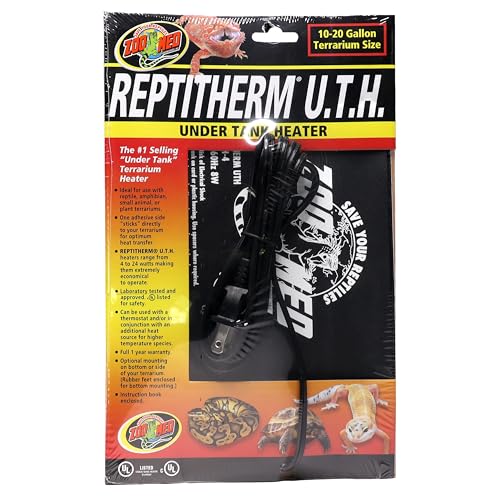
Zoo Med
Zoo Med ReptiTherm Under Tank Heater
Under tank heater that creates a warm area on the bottom of the terrarium. Self-adhesive for easy installation.
+ Easy installation
+ Energy efficient
- No thermostat included
- Can overheat without thermostat

Fluker Ceramic
Ceramic Heat Emitter
Fluker Ceramic reptile heating listed for comparison. We have not yet researched this product in depth — check the full specifications on the retailer's page.

Reptile Basking
Reptile Heat Bulb Lamp
Reptile Basking reptile heating listed for comparison. We have not yet researched this product in depth — check the full specifications on the retailer's page.
